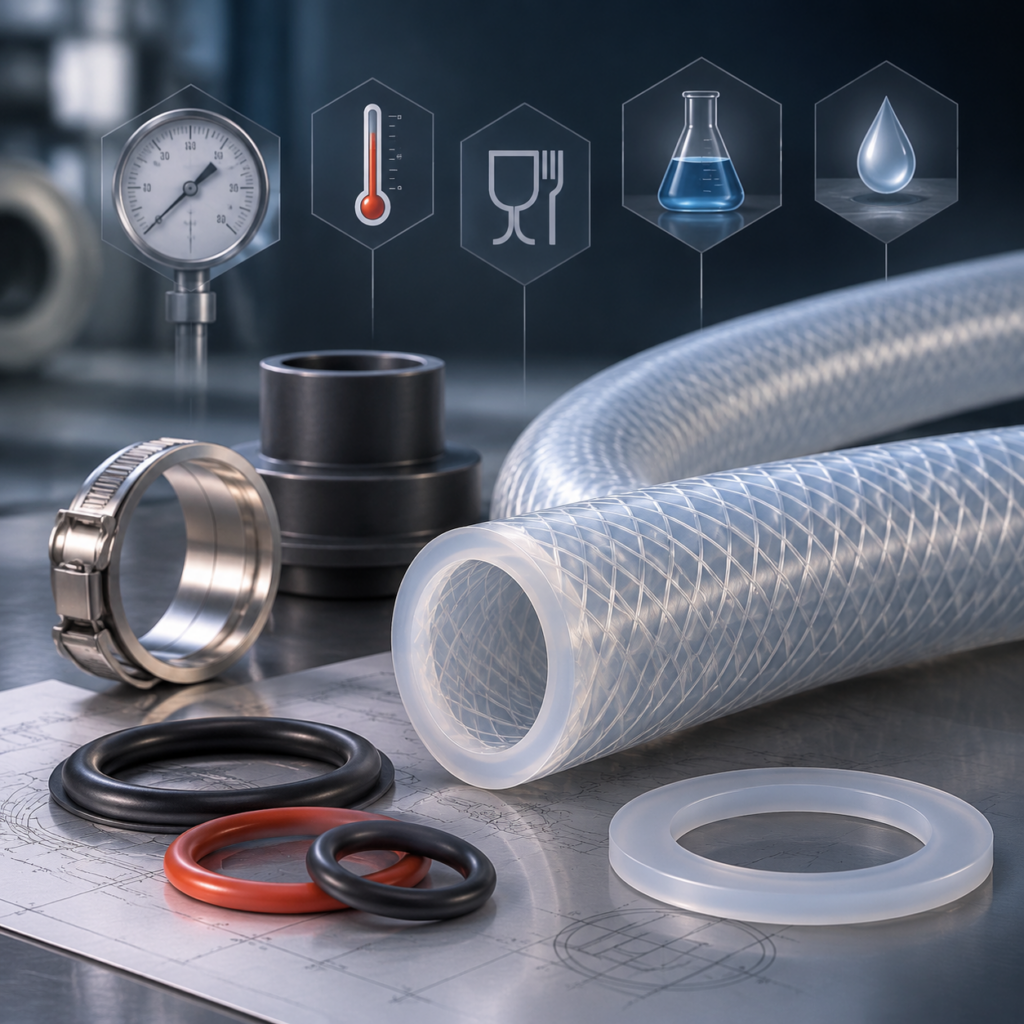
A braided silicone hose should not be approved from its appearance, reinforcement label or a general market trend. The buyer must first define the transfer duty, installed route, end connections, contact path and acceptance criteria. The braid is one part of a complete construction; it does not independently establish pressure capability, vacuum resistance or suitability for a food-contact project.
A provider-supplied excerpt from Fortune Business Insights forecasts continued expansion of the broader hose market and associates demand with industrial automation, infrastructure and fluid-transfer applications. It also describes interest in flexible, reinforced and temperature-tolerant hose systems. These market observations provide background, not a specification for an individual hose or assembly. [1]
Industry consolidation is another part of the commercial context. A supplied Power Transmission industry-news excerpt reports an acquisition involving a hose fittings manufacturer. This does not prove any technical result, but it reinforces a useful procurement principle: the hose and its connection system should be considered together rather than purchased as unrelated components. [2]
Does braiding automatically establish a pressure rating?
No. Reinforcement may be requested as part of the construction, but the required duty must be stated before braid type, placement, layer dimensions and end treatment can be reviewed. An illustration or family description cannot establish the capability of the finished assembly.
For a Braided Silicone Hose Project, provide the normal working pressure, transient conditions, vacuum exposure and operating temperature in degrees Celsius. State whether the hose will experience positive pressure, suction or both. These conditions can require different construction and validation decisions.
Define the installed assembly
A hose that is acceptable as a free length may behave differently after it is routed, supported and connected. Record the available bend space, expected movement and support points. Avoid replacing these details with a generic request for a flexible hose.
Specify the ends and retention method
Supply the fitting geometry and identify whether clamps, crimps or another retention arrangement are required. Show any exposed end surfaces that could enter the contact path. Working pressure, leakage, burst behavior and fitting retention are separate acceptance questions, so the requested checks should identify the complete assembly being assessed.
- Provide fitting drawings or controlled dimensions.
- Identify the retention method and installation procedure.
- State whether the assembly will be pulled, flexed or repositioned.
- Define leak and retention acceptance conditions.
Review the complete food-contact path
For a food-contact project, do not review only the silicone inner layer. Consider the inner layer, exposed cut ends, fittings, retention components and any other assembly materials that may contact the transferred product.
Ask exactly what each supplied document covers. Relevant questions include whether the evidence applies to a formulation, a test specimen, an unreinforced tube or the proposed finished braided hose. A report for unreinforced tubing should not be assumed to cover added reinforcement, exposed assembly materials or different use conditions.
Describe food and cleaning exposure
Provide the intended food or process medium, contact pattern and cleaning cycle for review. The project information supplied for this hose family does not promise a particular cleaning regime, food-contact approval or certification. Evidence requirements and acceptance criteria therefore need to be agreed for the proposed construction and destination.
Build a usable inquiry package
- Geometry: State inside diameter, outside diameter, length and tolerances in millimetres.
- Construction request: Describe the requested inner layer, reinforcement and outer layer for feasibility review.
- Duty: Record working and transient pressure, vacuum and temperature.
- Installation: Show minimum bend space, movement, support and routing constraints.
- Ends: Provide fitting geometry, retention method and exposed contact surfaces.
- Evidence and acceptance: Define the required food-contact evidence scope and assembly pressure, leak and retention test conditions.
Keep market forecasts separate from product approval
Market-size projections can help with strategic planning, but they cannot answer whether a particular braided silicone hose will work in a specific transfer route. Product approval should remain tied to the proposed compound and construction, dimensional tolerances, operating conditions, connection arrangement and agreed acceptance criteria.
The practical purchasing question is not simply whether the hose is braided. It is whether the reviewed hose-and-fitting assembly matches the defined route, duty, contact path and acceptance plan.
The next step is to prepare one controlled inquiry containing the geometry, service conditions, routing, fittings, cleaning exposure and requested evidence. That gives the supplier a specific basis for feasibility review without treating reinforcement or market growth as proof of finished-product performance.
Research sources
External sources provide background. Search results are not Google search volume or verified performance specifications for Xinwei products.
- [1] Hose Market Share, Trends & Growth Analysis, 2034 — 2026-10-26T00:00:00Z — estimated source date
- [2] Industry News — 2026-10-28T00:00:00Z — estimated source date