
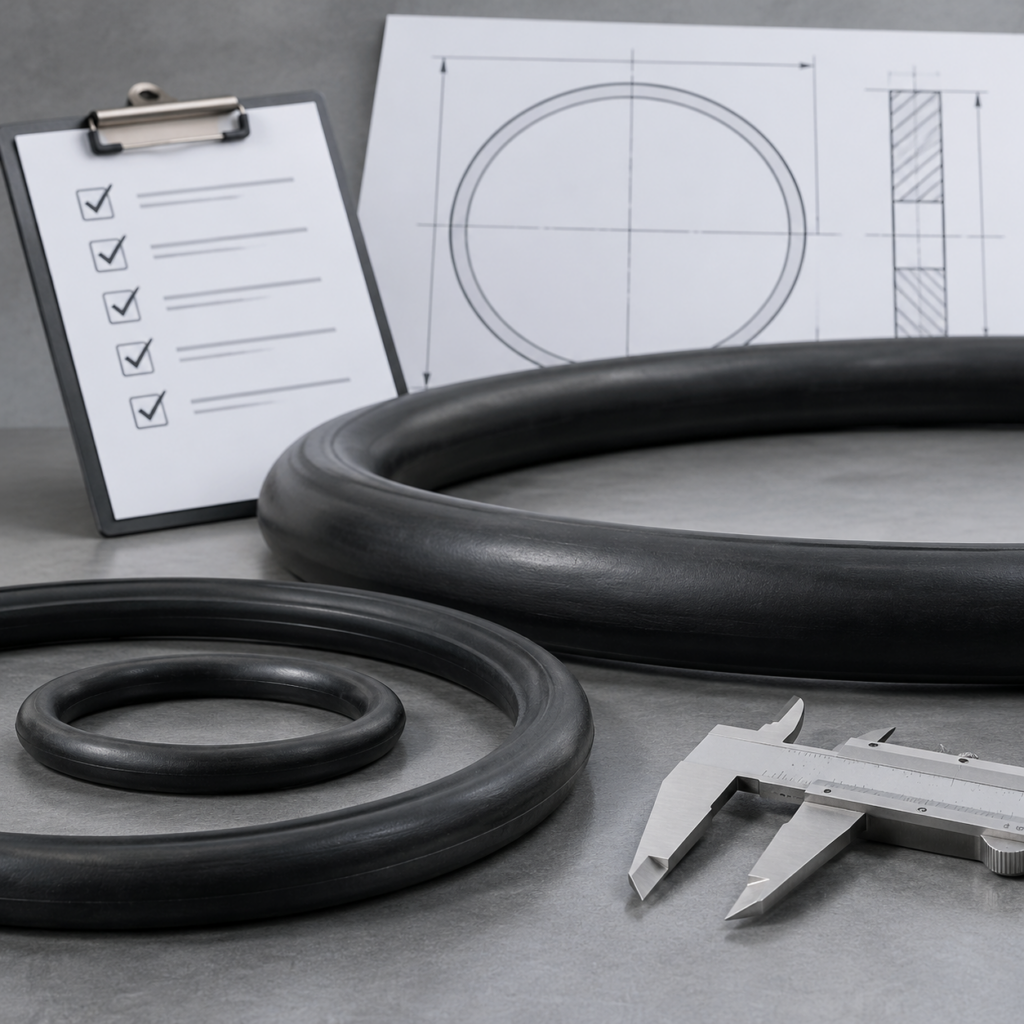
Direct answer: When sourcing a large-diameter sealing ring from China or another global supply base, do not begin with supplier size or an old ring’s circumference alone. Begin with the complete sealing route, the cross-section, the condition in which dimensions apply, the permitted manufacturing route and the project’s acceptance criteria. General supplier-selection commentary also emphasizes application understanding and repeatable process control rather than product range alone. [1]
The Large-Diameter Sealing Rings project page is intended for covers and housings where perimeter control, handling and installation space require particular attention. It does not state a maximum diameter, seamless construction, pressure rating or certified performance.
Why the perimeter must be defined precisely
A large ring is not simply a small ring enlarged. Its free shape may be affected by handling, storage and the surface used for measurement. A buyer should therefore identify which dimension controls the design: nominal inside diameter, outside diameter or the centerline route around the housing.
State whether each dimension applies to the ring in its free state, laid on an inspection fixture or installed in the groove. If an existing ring is supplied as a sample, record its storage and service history. Its measured circumference may reflect distortion rather than the intended nominal geometry.
Inputs to include with the inquiry
- Full sealing route: Provide the complete housing or cover drawing, including straight sections, curves and corner transitions.
- Cross-section: Define the section geometry and dimensions in millimetres rather than relying only on photographs.
- Reference state: Specify whether inspection occurs free, on a fixture or in the installed condition.
- Joint policy: State whether a continuous-only construction is required or whether a joint may be considered at an identified location.
- Installation conditions: Explain groove retention, expected assembly stretch, closure sequence and available access.
- Operating exposure: List the medium, temperature, pressure or vacuum units, and operating cycle for project review.
- Acceptance criteria: Agree how dimensions, joint condition and installed fit will be evaluated before production.
Background guidance on custom rubber profiles similarly treats geometry and installation conditions as separate selection questions rather than assuming material choice alone determines suitability. [2] That principle is useful here, but it is not a tested specification for this sealing-ring project.
Resolve the manufacturing route before tooling
Do not assume that a jointed ring and a one-piece molded ring are interchangeable. The design owner should approve the proposed manufacturing route, any joint location and the validation required for the assembly. Ask the supplier to identify how the ring will be supported during production, inspection, packaging and transport.
If a joint is potentially acceptable, define its permitted location and acceptance standard in the controlled drawing. If the design requires a continuous ring, state that requirement explicitly and ask whether the proposed process can meet it; do not infer seamless construction from the product category.
Check installation and inspection together
A dimension can be technically clear yet impractical to inspect or install. Confirm whether the assembly team can place the full perimeter without excessive stretching, twisting or unsupported hanging. Installation photographs can clarify access restrictions that a cropped component drawing may miss.
The inspection method should reproduce the agreed reference state. A free-state measurement, fixture measurement and installed-groove check answer different questions, so the purchase specification should not mix them without defined tolerances and procedures.
Questions to close before ordering
- Which perimeter dimension controls the fit?
- What is the complete cross-section and groove route?
- In what condition will the ring be measured?
- Is any joint permitted, and who approves its location?
- How will the ring be retained and accessed during assembly?
- What medium, temperature, pressure or vacuum, and cycle must be reviewed?
- What fixture, dimensional method and visual criteria define acceptance?
- What packaging support is needed to preserve the perimeter during shipment?
A useful quotation request defines the assembly and inspection problem, not merely the nominal diameter.
Practical next step
Send the complete assembly route, section drawing, installation sequence, joint policy, reference measurement condition, operating exposure and required quantity. Treat compound selection, tolerances and acceptance criteria as project decisions to be agreed with the supplier. Where approval, pressure capability or service performance is required, request applicable project-specific evidence rather than assuming it from a general product description.
Research sources
External sources provide background. Search results are not Google search volume or verified performance specifications for Xinwei products.
- [1] Leading Rubber Seal Manufacturers in China Expand Global Supply — 2026-10-23T00:00:00Z — estimated source date
- [2] Industrial Rubber Profiles: 2026 Buyer’s Guide to Custom, High-Performance Sealing Solutions-Hebei Fengming|Sealing strip and sealing component manufacturers — 2026-10-25T00:00:00Z — estimated source date