General engineering information; project-specific suitability requires review. General information does not establish a Xinwei product rating or suitability for a specific application.
Start with the circuit and the drawing
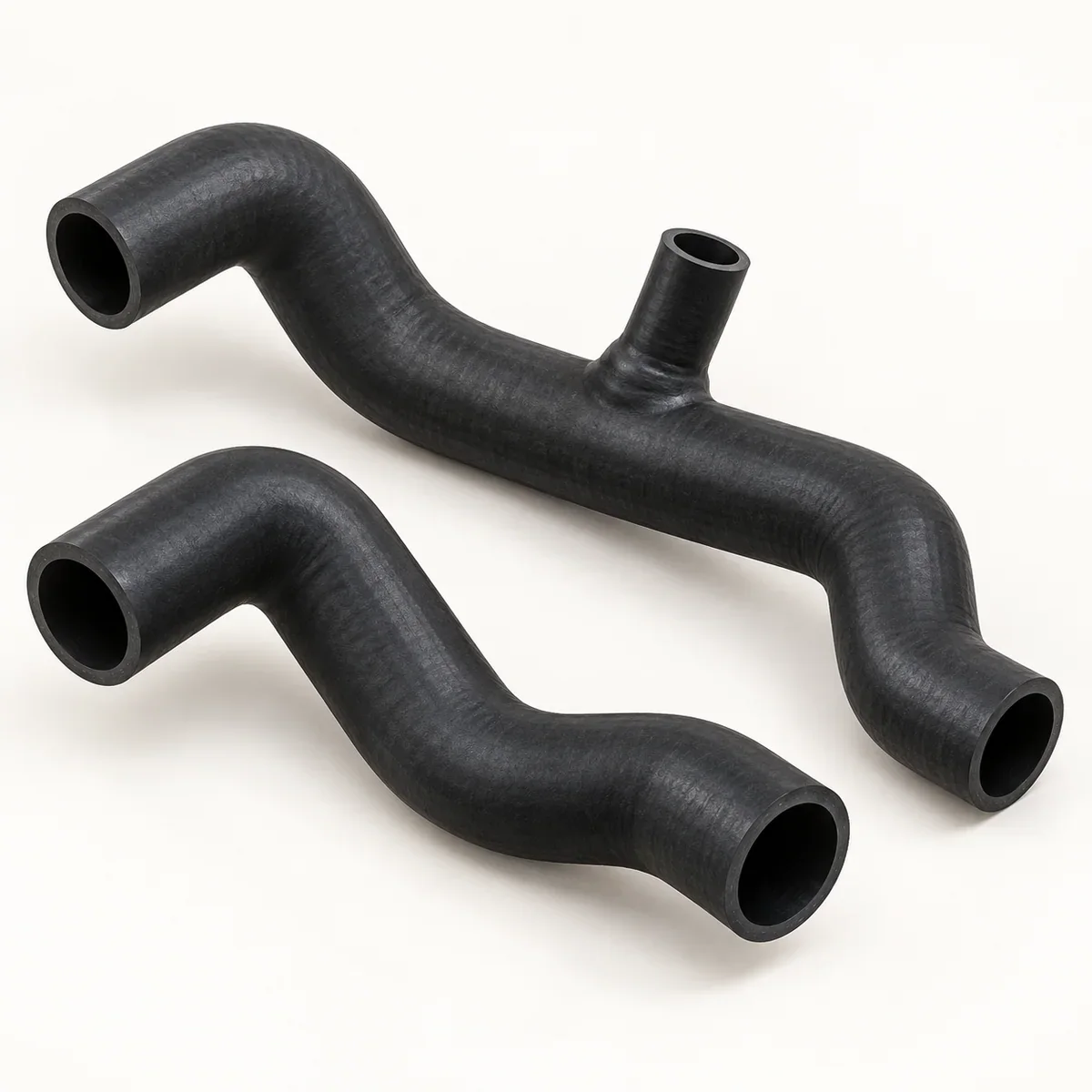
Name the actual service before choosing the shape: coolant, intake air, breather vapor, appliance discharge or food-contact transfer. Describe what passes through the hose and what reaches its outside. Then locate each end, branch and mounting point in a controlled drawing.
1. Label every interface
Use end A, end B and branch labels consistently. Dimension the bore, outside envelope, insertion length and sealing/clamping zone at each connection. Include the fitting bead or barb and the available clamp-installation space. Similar IDs do not establish equivalent fitting retention.
- For oval or special profiles, give axes or a complete section.
- For unequal ends, do not repeat one end's dimensions by assumption.
- Identify the fitting and retention method that will be tested.
2. Describe the route in three dimensions
Provide leg lengths, centerline bends, offsets and end clocking. State the drawing datums and whether dimensions describe free or installed state. Add the nearby parts, supports and motion envelope. The available bend space is a requirement to review, not an assumed property of a hose family.
3. Record duty as a cycle
List working and transient pressure, vacuum, temperature and duration with units. Include cold starts, shutdown, cleaning and external heat. State flow or drainage requirements if they control the task. A working-pressure claim cannot be derived from wall thickness or braid appearance.
- Coolant: fluid formulation and mixture.
- Intake: suction/boost distinction, ports and airflow task.
- Vent: vapor, oil mist, condensate and applicable system requirements.
- Appliance: detergents, debris, pump discharge and repeated movement.
4. Review the proposed construction
Ask the supplier to identify the proposed inner material, layers, reinforcement and end treatment. Mark customer-mandated construction separately from features still open for feasibility review. Gates' identified coolant-hose construction is a useful example of why hose data belong to a particular construction; its ratings cannot be applied to a different custom hose.
5. Define a release plan that answers the risks
Agree drawing inspection and installed fit first, then the leak, pressure/vacuum, retention, movement or durability tests relevant to the circuit. For pump tubing, add the pump-head size, settings, trial duration and flow/dose targets. For food-contact service, add a separate documentation assessment; mechanical testing cannot answer migration or composition questions.
A compact RFQ handover
Send one package containing the drawing/model revisions, medium and cycle, fittings/clamps, quantity, requested documents and acceptance plan. Ask the supplier to identify assumptions and proposed deviations in the quotation. That makes proposals comparable without inventing a common pressure or temperature rating for every hose.
Related project families
- Custom Molded Automotive Hoses
- Coolant Elbow Hoses
- Appliance Drain Hoses
- Braided Silicone Hose Projects
- Silicone Pump Tubing Projects
General references and scope
These references explain general engineering or regulatory context. They are not Xinwei finished-product specifications, test results or compliance evidence.
- Wire Inserted Green Stripe Coolant Hose — Illustrates that reinforcement, bend radius, dimensions and application limitations belong to an identified hose construction. No Gates rating, standard compliance or construction is claimed for Xinwei.
- Bio-Sil Precision Tubing — Demonstrates that pumping tubing uses a specific formulation and wall-thickness/concentricity control. Medical application data are not food-contact evidence, pump life evidence or Xinwei capability.