General engineering information; project-specific suitability requires review. General information does not establish a Xinwei product rating or suitability for a specific application.
Ask a precise question
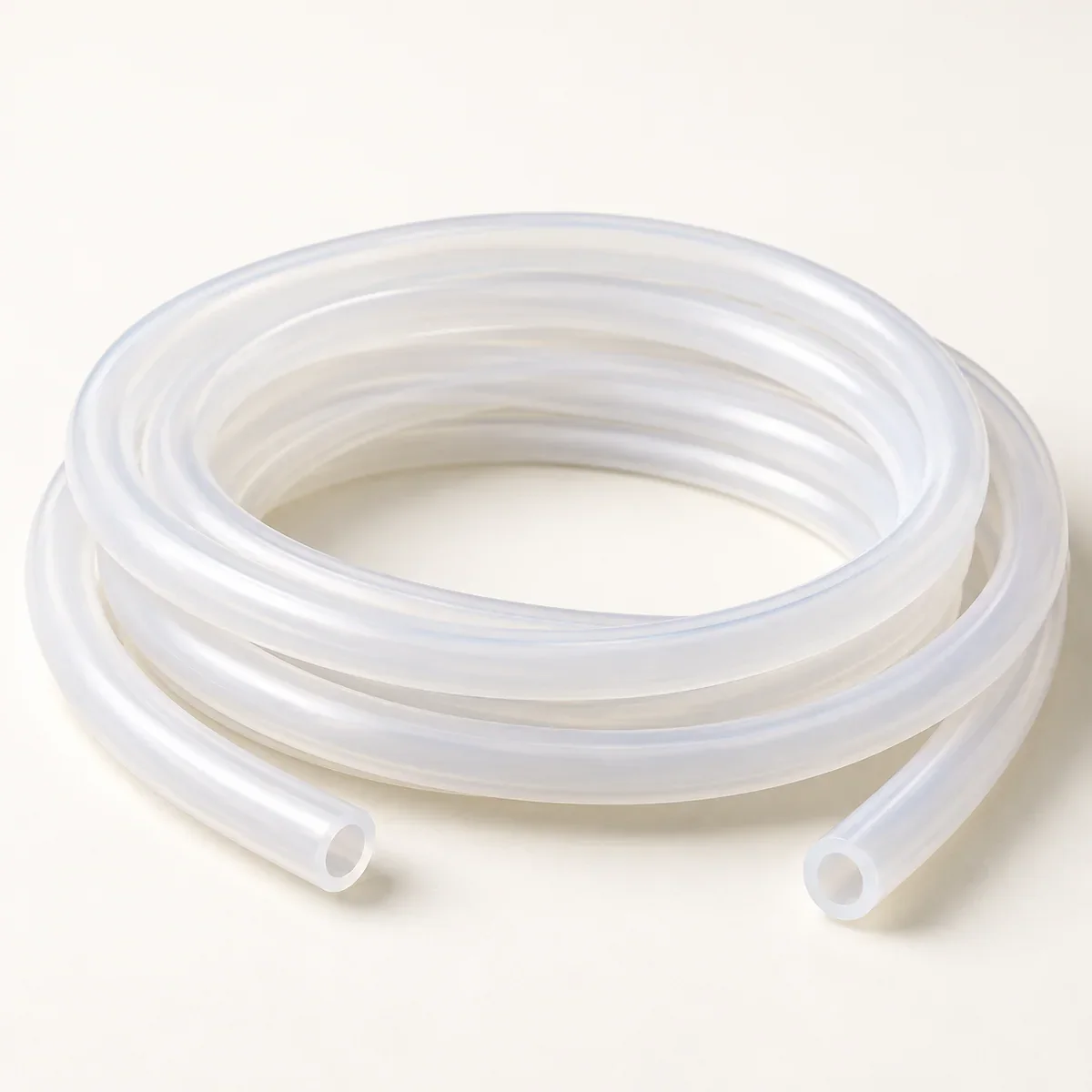
The useful question is whether the proposed hose is supported for your intended food-contact conditions and destination. Silicone, a clear appearance or a general food-grade label cannot answer that alone. Start the review before approving the material and construction.
1. Define the intended use
Write down the actual food or ingredient, contact time, temperature, reuse cycle and cleaning conditions. Identify fatty, alcoholic or acidic exposure where relevant. Describe whether the hose is straight transfer tubing, a reinforced assembly, a formed elbow or a pump tube; additional layers, fittings and exposed ends can change the evidence questions.
- Destination country or market and buyer specification.
- Food/ingredient and foreseeable contact conditions.
- Cleaning agents, concentrations and time/temperature.
- Finished geometry, end fittings and any assembly materials.
2. Distinguish the documents
A raw-material declaration identifies a starting material and its stated conditions. A compound statement addresses a specific formulation. A laboratory report describes identified specimens and a test scope. A finished-product assessment must connect these to the supplied hose or assembly. Keep the document owner, product/compound reference, date and covered conditions visible in the review record.
3. Read the U.S. scope carefully
21 CFR 177.2600 addresses rubber articles intended for repeated use subject to its provisions. It includes composition provisions and requirements differentiated by use; its aqueous- and fatty-food extraction provisions refer to the food-contact surface in finished form. A statement using FDA language therefore needs its precise basis and applicable conditions, rather than being treated as a general product certification.
4. Check the European destination
The European Commission describes a general food-contact framework covering safety, documentation and traceability, alongside good manufacturing practice and national provisions. Do not assume the plastics rules alone settle a silicone or rubber hose project. The EU kitchenware guidance cited below also explains the importance of foreseeable use and national rules; it is context, not an industrial-hose test plan.
5. Build an evidence-to-part map
Use a short matrix in your procurement file: requirement, proposed part/compound, supporting document, covered condition and unresolved gap. Check whether color, additives, reinforcement, cure or finished processing have changed from the tested specimen. Ask a qualified reviewer or test laboratory which assessment is needed for the actual market and use.
- Does the document identify the same proposed formulation and construction?
- Are food type, time, temperature and repeated use covered?
- Are the test specimen and the supplied contact surface connected clearly?
- What change requires a new review, and who approves it?
Keep mechanical qualification separate
Food-contact evidence does not establish working pressure, vacuum resistance, cleanability or pump life. Define those acceptance tasks separately. No product-specific food-contact report was identified in the supplied Xinwei business record, so this guide makes no FDA-approved or LFGB-certified claim.
A useful request to include in the inquiry
Request a proposed documentation package tied to the identified finished hose and the use conditions you supply, with any limitations or missing evidence stated. Do not accept a certificate logo, a management-system certificate or another supplier's report as a substitute for that mapping.
Related project families
- Silicone Transfer Tubing Projects
- Braided Silicone Hose Projects
- Formed Silicone Hose Elbow Projects
- Silicone Pump Tubing Projects
- Silicone Cover Gaskets
General references and scope
These references explain general engineering or regulatory context. They are not Xinwei finished-product specifications, test results or compliance evidence.
- 21 CFR 177.2600 — Rubber articles intended for repeated use — Official current text, particularly paragraphs (a)–(c) on composition and (d)–(g) on use/finished form/extraction/cleansing. Regulatory context only; no Xinwei product compliance is established.
- Food Contact Materials — Legislation — EU framework, good manufacturing practice, documentation, traceability and national provisions. Not a declaration that a silicone product satisfies every destination requirement.
- Testing conditions for kitchenware articles in contact with foodstuffs — 2023 kitchenware guidance metadata: foreseeable use affects test conditions, and material-specific/national rules matter. Used for documentation questions only, not industrial hose test instructions.